Thursday, December 15, 2016

Unit 5 Reflection

   This unit went deeper into genetics, and it began with the genetic code. Deoxyribose nucleic acid, or DNA, is structured as a double helix, where two strands are twisted around each other. DNA is made up of nucleotides, with 3 parts: The nitrogen base, phosphate group, and sugar(deoxyribose). The phosphate and the sugar make up the sides of the ladder and the bases are the steps. The DNA double helix is antiparallel, and the backbones run in opposite(5'  to 3' ) directions. The nitrogenous bases come in two types: double rings called purines (adenine and guanine) and single rings called pyrimidines(thymine and cytosine). There are base pair rules where A goes with T and G goes with C when they match up. The order of the bases in your DNA makeup special codes for each and every trait you have.

DNA structure
https://upload.wikimedia.org/wikipedia/commons/4/4c/DNA_Structure%2BKey%2BLabelled.pn_NoBB.png

   The second lesson was all about DNA replication and how it occurs. Semi-conservative DNA replication is the process of creating two identical strands of DNA from one strand. The two strands end up with half of the original strand. All of this happens in 2 steps: Unzipping and Matching. In unzipping, the enzyme helicase unzips the DNA by breaking the hydrogen bonds that hold the nitrogen bases together. In matching, the enzyme DNA polymerase adds the matching nucleotides(with bases) to each strand. This results in two DNA molecules that are identical to the original strand.
DNA replication

https://upload.wikimedia.org/wikipedia/commons/5/50/0323_DNA_Replication.jpg


   Lesson three focused on DNA, RNA and proteins, and how important these substances are to our body. There are some structural differences between RNA and DNA. RNA, unlike DNA, is single stranded, has ribose instead of deoxyribose sugars, and it contains uracil instead of a thymine base. RNA serves as a blueprint, or temporary copy of DNA, the master copy. RNA delivers the gene copy to the ribosomes, where it is used to make proteins.Transcription in the nucleus is the process where RNA polymerase reads and copies the DNA code(gene) for a protein as an mRNA copy. In transcription, the DNA unzips, the RNA polymerase matches a spare nucleotide to make an RNA strand(with U instead of T). Messenger RNA or mRNA is produced and it leaves the nucleus for the cytoplasm. In translation, mRNA arrives at the ribosome where it reads mRNA 3 bases at a time and translates DNA language (nucleotides: A, C, G, U) into protein language(amino acids). Each 3 base sequence is known as a codon, that codes for one amino acid. There are "start" and "stop" codons so ribosomes know when to translate. Translation results in long chains of amino acids or primary structures to be formed. That chain then folds and combines with other chains to become a protein. All in all, the steps from DNA to protein are as shown: The DNA sequence is transcribed into RNA with the different base pairs. Then codons are identified and translated into amino acids, where a protein sequence is created.
DNA to Protein digram

https://upload.wikimedia.org/wikipedia/commons/f/f2/0324_DNA_Translation_and_Codons.jpg


   The fourth lesson was about the different types of mutations (change in DNA code) and mutagens (factors that cause mutations). Point mutations occur at a single point in the DNA sequence, and it includes substituion where a nucleotide is substituted for another, and frameshift mutations with insertion and deletion(of single bases), that shifts how the entire sequence is read. Some other types of mutations include inversion, where DNA breaks off and bonds in reverse order, as well as translocation, where part of a chromosome breaks off and bonds with another chromosome. Mutations that change the protein a lot are more harmful, whereas a mutation that has little effect on a protein has little harm.


   The last lesson was about gene expression and regulation. Gene expression is the process of a gene being used to produce a phenotype or gene product and gene regulation is a mechanism used by the cell to increase or decrease the expression of a gene. Because every cell in your body has the same DNA, gene expression is required to turn off/on the genes that aren't needed. This creates specialized functions for different cells. Gene regulation is needed so cells don't waste energy overexpressing genes. There is a variety of steps to control gene expression, and the series of genes used to control the expression of a single gene is called the operon. The promoter is the location on DNA where RNA polymerase attaches. The operator is the switch or segment of DNA at the start of the gene that prevents or allows RNA polymerase(transcription) to attach and read the gene.The repressors affect the DNA's binding ability whether the gene is present or absent. A good example is the Lac operon, for bacteria, because eukaryotic regulation is much more complicated.
   I feel like at first, I struggled to grasp some of the more complex concepts, but after reviewing to write this reflection, I feel like a lot of it came into place. Throughout the unit, I was doing really well remembering the broader outline of each lesson, which I think adds to my understanding. Personally, I want to learn about how some of these processes occur in more detail as to where the materials come from(like in DNA replication). I wonder what all of it looks like, but after watching the videos in the vodcasts, I have a better idea for it. I also want to learn more about how all of these things come together, in a visual representation, which I think will be a great tool for studying.
   Overall, I feel like I have grown as a student. Looking at all of my other reflections, my classroom-based skills have definitely improved, as well as my mental awareness. After learning about mindfulness and the growth mindset, I've been increasing applying my effort and energy in a non-exhausting way, as well as accepting and learning from my mistakes. One of the biggest thingsI have gained from this, is how I am adjusting my study habits. After discovering I was a multimodal learning in the last unit, I've learned to study more actively and in different ways. Also, throughout the labs we did in this unit, I feel like I've been a better critical thinker as well.



Tuesday, December 13, 2016

Protein Synthesis Lab

   The steps to make a protein begins with Transcription(making a copy), where a section of DNA(gene) is copied by an enzyme and the copy  is called mRNA, with uracil instead of thymine (like in DNA). The mRNA leaves the nucleus and heads to the ribosome for translation( uses the copy to make a protein) where it bonds to a ribosome that makes a protein. The ribosome reads the first three bases of the sequence, called a codon, that shows which amino acid corresponds with that sequence. Those amino acids are then bonded together, and after the mRNA is done being translated, it folds up to become a protein.

   Changing bases in a DNA molecule creates mutations with little or great effect. A frameshift mutation, with deletion and insertion, shifts the way the whole sequence is read. If it is shifted earlier, there is a greater effect to the DNA being read. For example, if the T was inserted at the end of the sequence for activity 2, it would have little effect on "shifting" it. Substitution, where one base is exchanged for another, seemed to have little affect for the most part because the whole sequence was not shifted, but if used in a certain way, could have the greatest effect of all.
EX: Substitution    Insertion      Deletion
      ACG         ACTG        AC_
      ATG 

   For step seven, we got to choose our own mutation that would affect the gene the most. I chose substution, and I substituted a base in the second codon for another, and it created a stop codon. This shortened the length of the entire sequence, making it only a start and a stop. This had a greater effect than even a frameshift mutation, because the whole protein was changed. This shows how when and where a mutation occurs is a big factor to its effect on an individual protein.


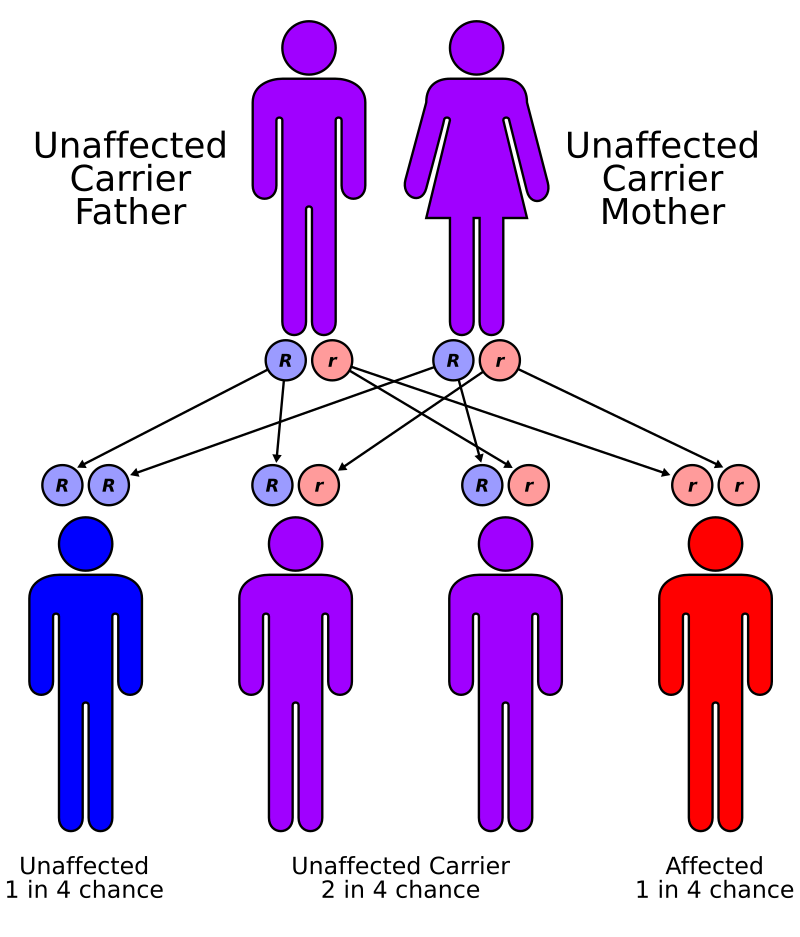
   Proteins carry out many of our bodily functions, and these proteins that make up our bodies are determined by their amino acid sequence. When the proteins are being created, a mutation may change that sequence, lessening the proteins ability to carry out its job, harming an individual in the long run. Luckily, small, harmless mutations are the most common, and they have little effect on an organism. Phenylketonuria, or PKU, is a chronic disease caused by a genetic mutation that is inherited. It causes an increase in the levels of phenylalanine(an amino acid found in many artificial sweetners) in the blood. If it is not treated it can lead to serious health problems.
Inhertiance pattern for Phenylketonuria

Sources:

"Phenylketonuria - Genetics Home Reference." U.S. National Library of Medicine. National Institutes of Health, n.d. Web. 13 Dec. 2016. <https://ghr.nlm.nih.gov/condition/phenylketonuria>.

Version 8.25 from the Textbook OpenStax Anatomy and Physiology Published May 18, 2016. Digital image. Wikimedia. N.p., 18 May 2016. Web. 13 Dec. 2016. <https://commons.wikimedia.org/wiki/File:0324_DNA_Translation_and_Codons.jpg>.

Phenylketonuria Inhertiance Pattern. Digital image. Wikimedia. N.p., n.d. Web. 13 Dec. 2016. <https://upload.wikimedia.org/wikipedia/commons/3/3e/Autorecessive.svg>.


Monday, December 5, 2016

Human DNA Extraction Lab Conclusion

   In this lab, we asked the question, "How can DNA be separated from cheek cells in order to study it?" We found that the separation of DNA occurs in three simple steps: homogenization, lysis, and precipitation. It is necessary to first break down the cell membrane and nuclear material by homogenizing, or to making similar in function, the cell tissue with a polar(covalent bond's electron's shared unequally) liquid. During the homogenization steps, the outer layer of the polar DNA cells broke down in the polar Gatorade. We created a mixture of Gatorade and saliva(polar) and then we added cold alcohol (nonpolar, where covalent bond's electrons are shared evenly). The combonation of the polar and nonpolar solutions created a precipate or separated substance. After collecting some information we learned that the sodium chloride(salt) added to the solution assists the separation by blocking negative phosphate ends of the DNA, enabling them to travel closer together. Soap is then added to the solution to lyse, or destroy the cells and release the opened DNA. Then catobolic proteases, a group of enzymes(catalysts, or substances used to speed up chemical reactions) used to break down protiens called histones(structural proteins of chromosomes), are mixed in the form of pineapple juice. Then, 95% isopropanol alcohol, with a different density than the mixture, is layered above it in a test tube. Because the DNA is polar and the alcohol is nonpolar, DNA is separated from the solution.
   While our hypothesis was supported by our data, there could have been errors due to the fact that our table group was challenged to number the procedure on our own. This could be improved by practicing these important skills beforehand rather than suddenly in the face of a new lab. Another possible error could have been the non-specific amount of gatorade being used in the mixture to collect the DNA. This problem can be solved by simply using measuring cups, or labeling the disposable paper cups with measurements for accuracy. These errors would have skewed the results greatly if brought to an extreme, but luckily our group seemed to handle the lab pretty well.
   This experiment tested our basic lab skills as well as our ability to apply collected information. This lab was done to demonstrate the complex process of achieving a precipitate, by using the basic knowledge we have learned from recent as well as previous vodcasts. From this lab, I not only learned a lot of new vocabulary, but how it relates to the concepts we have been studying in class. This extra background helps me put everything together to make a lot more sense, aiding me in understanding these major concepts. Based on my experience from this lab, I feel like I can especially apply the critical thinking skills I've been introduced to in future experiments.


Monday, November 28, 2016

Unit 4 Reflection

   In class, we recently did the "Coin Sex Lab" where we experimented with probabilty and predictability while applying scientific concepts we learned throughout the unit. In this lab, we collected information and defined many terms. Coins served as a model for our genetics concept when we covered them with tape and labelled them with different genotypes. We created punnet sqaures for each cross of phenotypes, and predicted possible outcomes. We then flipped them silmultaneuosly, stimulating sex, and testing probability. Then we recorded the genotypes and phenotypes as well as calculating the ratios. Lastly, we analyzed our results by comparing our results to our predictions, and relating parts of the lab to scientific concepts learned in class. We did multiple crosses;  In our dyhybrid cross stimulation, we tested two individuals and their double heterozygous phenotypes. We assessed the possible gametes based off the cross, as well as calculating a phenotypic ratio in our dyhybrid punnett square. We expected to have two homozygous children, based off of our punnet square calculations. The experiment resulted in zero homozygous children, which was not surprising considering the fact that homozygous individuals are less common. This shows that no matter what the probability may be there is no way to predict anything with complete certainty. The limit of using probability to predict offsprings' traits would be if parents were too dependent on the predictions. There is never a 100% chance of something happening, let alone an equal probability. For example, you could have two children, both girls, although the probability would be a 50/50 chance. In the dyhybrid cross, zero out of the 16 children were double homozygous for the two genes. Understanding this concept relates to the key concept of the broad differences between predicability and probability.
   This unit's essential understanding revolved around the basic principals of genetics, and how they tie in to the more complex areas of study. We focused mainly on the processes of mitosis and meiosis, forms of cell division, as well as comparing them and their widespread roles. We looked at genetics at a larger scale as well in the forms of reproduction, both sexual and asexual and the different types. We learned about how DNA is passed from generation to generation and how individuals either have the same 2 alleles(homozygous) or different 2 alleles(heterozygous). The basic vocabulary of genes, alleles, dominance, recessive, genotypes and phenotypes were explained as well as as Mendel's laws of segregation and independent assortment where gene pairs separate from each other when gametes are formed, or randomly during meiosis. Besides being introduced to the basic rules and reasons for making punnet squares, we were able to gradually apply them as we learned more concepts. We talked about X-linked and autosomal inheritance, and how dominant and recessive traits were to be portrayed in a punnet square, as well as understanding how the location of where a gene is inherited has an important role in genetic disorders. Codominance, where both alleles are completely expressed, as well as incomplete dominance where neither allele is completely dominant or recessive.  Gene linkage, epistasis, mulitifactorial disorders, and polygenetics were also summarized. Lastly, crosses were discussed. The different types of crosses that occur between parents during reproduction can determine the genotype and phenotype of the offspring by looking at certain ratios and relating the cross to all the other topics of this unit, like we assessed in the "Coin Sex Lab."
   Towards the end of the unit, the subjects we were studying began to get more complex, and as I forgot most of the foundation I had built earlier in the unit, I struggled to recall some of the most important information. My lack for review was a major setback, but after a lot I feel a lot more confident about knowing enough for the test.  The skills I was able to use during the lab helped everything make a lot more sense as it all came together. The infographic I created was an amazing help as for reviewing because I felt as if I got my ideas across efficiently. This made my infographic a  great, simple, studying tool to use early on in the studying process. I recently found out that my preferred learning style is multimodal which means that I can learn material presented in all different ways, but I have to go out of my way to study material in all these different forms. My modes of learning vary, but it takes some time to tap into the best way for me to learn in a certain subject. These results sound correct, because I have always been weary trying to find just one learning style. As for studying strategies, I know now that I need to give myself more time to study in different ways.
https://www.brightstorm.com/science/biology/mendelian-genetics/codominance-incomplete-dominance/

http://rannazbioblog.blogspot.com/2016/11/blog-post_21.html


Works cited for image: 

   The Cell Cycle. Digital image. Wikimedia. N.p., n.d. Web. 28 Nov. 2016. <https://upload.wikimedia.org/wikipedia/commons/thumb/2/2f/Animal_cell_cycle-en.svg/2000px-Animal_cell_cycle-en.svg.png>.

Friday, October 28, 2016

Is Sexual Reproduction Important?

   In Olivia Judson's national bestseller, Dr Tatiana's Sex Advice to All Creation, chapter one described the advantages and disadvantages of asexual reproduction. Judson describes the different types of organisms and how they reproduce. An interesting point she mentioned was that mammals actually clone(reproduce without sex) as well, in the form of twins. She talks about how cloning is more efficient in maintaining a good demographic for population growth. Miss Philodina Roseola , the bdelloid rutifer, descending from aseuxual reproducing creatures that evolved, and have lived for over 85 million years without miosis. Another species mentioned was the E. Coli bacterium, and for bacteria, who reproduce asexually, sex is just a way to aquire extra genes. For strictly asexual organisms, genetic developments are hard to create and adapt to. Genetic mutations are generally neutral and have little effect, but when there is an effect, small changes are likely to harm the organism. Judson concluded that harmful mutations are sometimes the reasons why most asexuals go extinct.There is now way to measure mutation rates at the moment, but if the rates are low the mutations would not be the reason after all. She says that mammals are the only ones where the asexual reproduction of adults are unknown. Shuffling genes can help us evade parasites and reduce the impact of harmful mutations, where sex really enables us to survive.

Wednesday, October 26, 2016

Unit 3 Reflection

   This unit was about different types of cells and their functions, as well as looking at the cell at both a microscopic and global level. We learned about the two different types of cells, eukaryotes(with a nucleus) and prokaryotes(without a nucleus). We learned about the roles and functions about different organelles in the cell.We also talked about protists, plant cells, and animal cells, as well as their similarities and differences.
    My strengths were mostly based on learning the different types of organelles, although I struggled to retain the information about their individual functions. We also learned about the unique characteristics of membranes, and how they are semi-permiable (bouncers), as well as the methods of transport(passive, active, and (facilitated) diffusion).
  An important part of the unit was about diffusion, passive movement across a concentration gradient to reach equilibrium, with multiple molecules moving across the membrane. Osmosis is diffusion across a semipermeable membrane, where the cell shrinks if the solvent is lost and the cell grows if the solvent is gained.
   Water balance was also discussed, focusing mainly on tonicity, the ability of a surrounding solute to cause a cell to gain/lose water through hypertonicity and hypotonicity. Also, cell evolution was discussed as well as the principals of endocytosis(material is taken into pockets/in-folds), exocytosis(material is released from vacuole from fusion with membrane) , phagocytosis(cell eating, packages food in vacuole), and pinocytosis(takes in liquid, pinches off cell).
  Light waves were also talked about in the vodcast, as well as the visible light spectrum. We learned that we recognize colors by interpreting the color that is reflected and not absorbed. Also how shorter wavelengths have higher energy and longer wave lengths have lower energy, and colors like red, violet, and blue(with short wavelengths and high energy) are best for growing plants under light, while colors like yellow and green(long wavelengths with low energy) are not optimal conditions for maximized plant growth.
  Most of
   Lastly, cellular respiration and photosynthesis were discussed. Photosynthesis occurs in the chloroplasts of autotrophs, while cellular respiration occurs in the mitochondrion of autotrophs and heterotrophs.The products of photosynthesis are the same as the reactants of cellular respiration(and vice versa), the only difference is that the chemical energy converted in photosynthesis is light energy and in cellular respiration heat energy is used from ATP. Photosynthesis occurs when light is absorbed in the chloroplasts, then the Calvin Cycle rotates 6 times in the thylakoid to produce one glucose molecule.
   I knew a lot about the basics of photosynthesis, and I vaguely understood cellular respiration up until this point. Once I saw them compared side by side, everything made sense and all the pieces seemed to fit together. I understood the concept much better, but it still took some effort to really learn to little details that were also very important.
   In cellular respiration(AKA aerobic respiration because it requires oxygen), Glycolysis in the cytoplasm begins the cycle to create 2 ATP, then the Krebs Cycle(AKA Citric Acid Cycle) creates another two and uses oxygen to produce energy carrying  molecules(NADH and FADH2) and carbon dioxide. Then the electron transport chain, which is located in the inner membrane of the mitochondria creates 32 ATP. After cellular respiration, where glucose and oxygen are put in, 36 ATP, 6 carbon dioxide molecules and 6 water molecules are produced.
   Overall, I think I was able to remember the outline of the events in this unit, while having a hard time recalling the details, but I think doing the CFU's really helped reinforce that practice and repetition for studying. A lot of big topics were covered, but now I feel like I have a really good foundation and understanding for what to expect later on. We observed things from different angles which I really think helped me broaden my understanding of the lessons, as it appealed to all different learning styles.